If you stand on the Stone Bridge in Riga and look downriver, your eye is pulled, almost involuntarily, to a strange three-legged silver spire rising out of an island in the middle of the Daugava. It does not look quite like anything else in the city. It does not look quite like anything else in the European Union, in fact. There is a good reason for that.
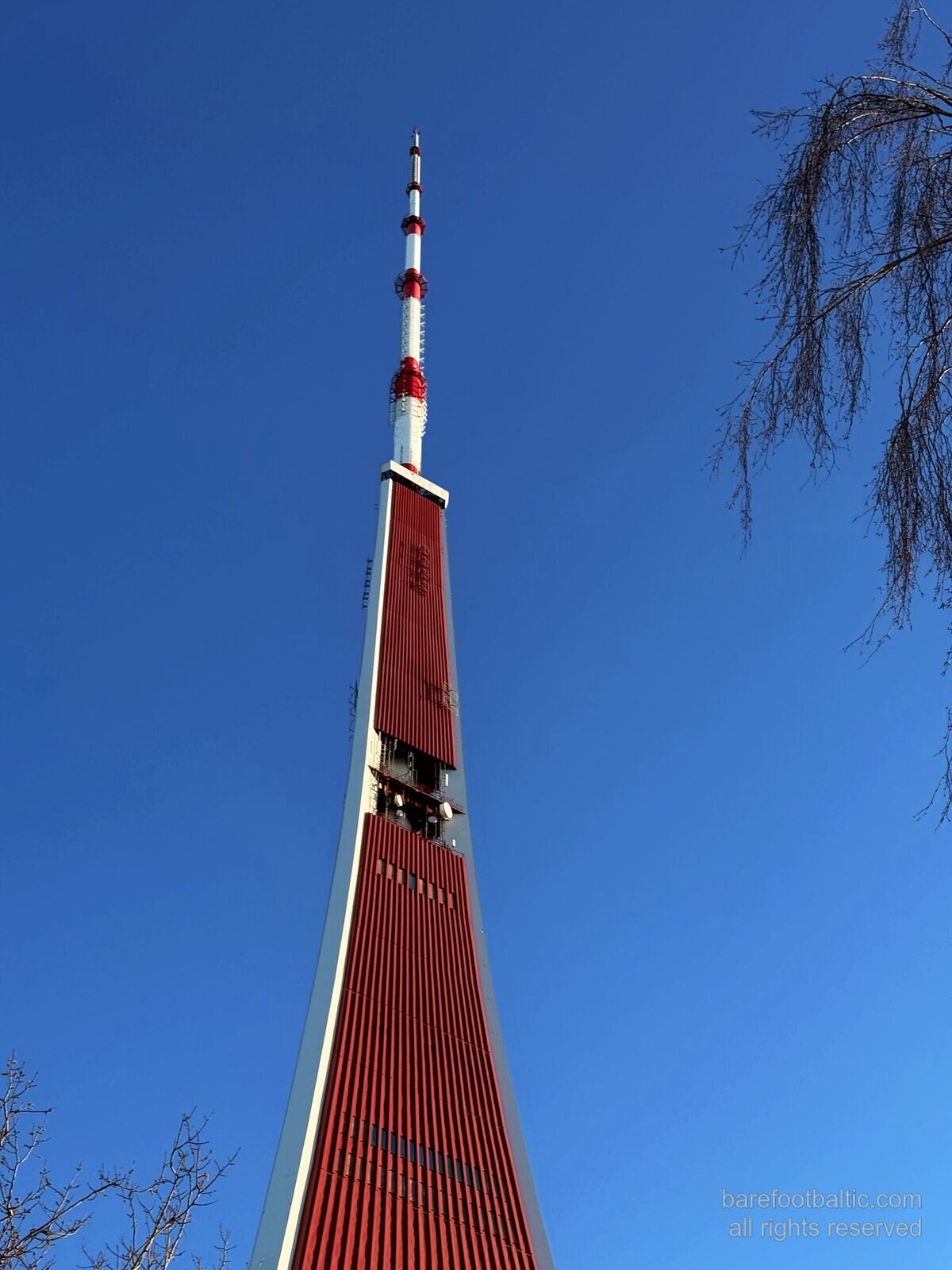
This is the Riga Radio and TV Tower, the Rīgas radio un televīzijas tornis, and at 368.5 metres, it is the tallest free-standing structure in the European Union. It has held that title for over twenty years, since Latvia joined the EU in 2004, and despite a wave of skyscraper-building in Warsaw, Frankfurt and Madrid in the last decade, nobody has come close to overtaking it.
It is also a building that almost no visitor to Riga knows the real story of. So this is a long-form guide for those who want it.
How tall is tall? The numbers in context
Towers are measured differently from buildings. A building has habitable floors with people working in them. A free-standing tower is a structure that supports itself without guy wires, so a guyed mast, the kind held up by cables, does not count. The Riga TV Tower is a true free-standing structure. Three concrete-and-steel legs splay outward at the base and meet again at 88 metres up, then carry the central shaft and antenna mast skyward without any external support. It can withstand winds of 44 metres per second, about 160 km/h, full hurricane force, without noticeable vibration at the top.
To give you a sense of scale, here is how Riga’s tower compares to other notable European structures.
| Structure | Location | Height | Notes |
|---|---|---|---|
| Ostankino Tower | Moscow, Russia | 540 m | Tallest free-standing structure in Europe overall (outside the EU) |
| Kyiv TV Tower | Kyiv, Ukraine | 385 m | Second-tallest in Europe (a guyed lattice tower) |
| Riga Radio and TV Tower | Riga, Latvia | 368.5 m | Tallest free-standing structure in the EU |
| Berlin TV Tower (Fernsehturm) | Berlin, Germany | 368 m | Half a metre shorter than Riga |
| Eiffel Tower | Paris, France | 330 m (with antenna) | 40+ metres shorter than Riga |
| Varso Tower | Warsaw, Poland | 310 m | Tallest habitable building in the EU (since 2022) |
| Commerzbank Tower | Frankfurt, Germany | 259 m | Was the tallest building in the EU before Varso |
| The Shard | London, UK | 309 m | Tallest in the UK, not in the EU |
A few things are worth noticing in this table.
First, the Eiffel Tower, Europe’s default tall-tower mental image, is almost forty-five metres shorter than the Riga TV Tower. It is also much further south and in a much more famous city. Outside Latvia, the fact barely registers. Since 1989, the Eiffel Tower has been outclassed in height by a tower on a Latvian river island.
Second, the Berlin Fernsehturm, which has been the icon of East Berlin for sixty years and is featured on a million postcards, is half a metre shorter than Riga’s tower. Half a metre. The two are essentially the same height, but Berlin gets the recognition.
Third, the Varso Tower in Warsaw, completed in 2022, is the EU’s tallest building. A building and a tower are different categories. Even fully built, Varso is almost sixty metres shorter than the Riga TV Tower. The Riga tower has held its title for so long because nobody else in the EU is in the business of building radio masts that tall any more. Terrestrial broadcasting is a Soviet-era ambition that the EU’s western half largely skipped.
Globally, the tower currently sits at around the fifteenth-tallest free-standing tower in the world, and the third-tallest in Europe as a whole, behind only Moscow’s Ostankino and Kyiv’s TV tower.
A tripod from the late Soviet imagination
The Riga TV Tower was built between 1979 and 1989, with money from the central Soviet government in Moscow. It was finished just months before the Soviet Union began to come apart. In some sense, it is a Soviet building that was never meant to be a Latvian one. And yet, against all expectation, it has become a building Latvians are fond of.
The architecture is unusual enough that the tower stands out even among Soviet-era radio towers. It belongs to a small family of late-Soviet tripod towers, designed with three load-bearing legs instead of the more common single shaft. There are only two other “tall” towers like this anywhere in the world. One is the Žižkov Television Tower in Prague (built 1985 to 1992). The other is the Avala Tower in Belgrade, first built in 1965, destroyed by NATO bombing in 1999, and rebuilt in 2010. Riga’s is the tallest of the three.
Here is roughly how the tower is put together, from bottom to top.
The base section rises the first 88 metres and is the most distinctive part of the structure. It comprises three curved legs, really three enormous reinforced-concrete pillars, splayed out at the bottom and converging higher up. Two of the pillars contain inclined high-speed lifts (running on rails, much like a funicular) that climb the slope of the leg in roughly 42 seconds. The third pillar contains the staircase and technical rooms. This sloping-elevator system was unusual for its time and is part of why engineers from across the Soviet bloc came to study the building.
The middle section, from 88 to 222 metres, is a cylindrical shaft clad in COR-TEN steel, the distinctive rust-coloured weathering steel that develops a stable patina over time and protects itself from further corrosion. American architects on the same continent were using the same material around the same time. Eero Saarinen was an early adopter, and Gunārs Birkerts of National Library fame worked under him. Late-Soviet architecture was much more in dialogue with Western modernism than Cold War mythology suggests.
The top section, from 222 to 368 metres, is the slim antenna spire that gives the tower its broadcasting function. The Soviet engineers used a clever construction trick here. Instead of building the spire upwards in the normal way, they assembled it from the top down. The very tip was put together first, fixed between three partially completed legs, and then jacked up incrementally as new sections were welded on below it. The antenna effectively grew downwards. This was necessary because the tower cranes available at the time could only reach about 107 metres, far short of the spire’s eventual height.
The foundation goes 27 metres into the bedrock of Zaķusala island, with the base itself sitting about 7 metres above mean sea level. There is a particular detail that engineers love. Riga’s temperature swings run to over 65 degrees Celsius from the coldest winter day to the hottest summer day, a spread recorded in 2010, and the very tip of the antenna can move as much as 2.4 metres sideways through thermal expansion alone. The structure is engineered to sway with it.
The observation level, when it is open to the public, sits at 97 metres, just above where the Vēja roze (“Wind Rose”) restaurant used to operate from 1989 until it closed in 2006. The original observation deck has never been one of those vertigo-inducing glass-floor European viewpoints. It was a Soviet-era technical building first and a tourist destination second. But on a clear day it offers a view that reaches as far as fifty kilometres, across the whole of Riga, the Daugava and its bridges, out to the Gulf of Riga, and on the rare clearest days even as far as Sigulda inland. There is a practical note at the end of this article, since the tower is currently closed for renovation.
January 1991, the night the country could have lost it
This is the part of the tower’s story that does not appear in tourist brochures, but that no Latvian who lived through it has forgotten.
To understand what happened around the TV Tower in January 1991, you have to understand what was happening in the Soviet Union at the time. By late 1990, the Soviet Union was visibly coming apart at the seams. Latvia, Lithuania and Estonia, which had been forcibly absorbed into the USSR in 1940, had already begun the process of declaring restored independence. Latvia had passed its Declaration on the Restoration of Independence on 4 May 1990. The Latvian government, the Augstākā Padome (Supreme Council), was operating in Riga as if the country were already free. Moscow refused to accept this.
In Moscow, hardline elements within the Soviet state began to plan a forceful response. The plan, in essence, was simple. Take control of the strategic infrastructure of each Baltic capital, the parliament, the broadcasting facilities, the international telephone exchange, the bridges, and from those buildings declare that legitimate Soviet rule had been restored. If you control the radio and television, you control the narrative. If you control the parliament and the telephone exchange, you control the apparatus of government.
The instrument for this in the Baltics was the Soviet OMON, the Otrjad militsii osobogo naznačenija, or “special-purpose police detachment.” Riga had its own OMON unit, originally established as part of the Latvian Soviet militia, which by late 1990 had defected to Moscow’s side and refused to take orders from the Latvian government. They were heavily armed, well organised, and willing to use force. They had already seized the Latvian national printing house, the Preses Nams, on 2 January 1991.
Then, on the night of 13 January 1991, the situation in neighbouring Lithuania exploded. Soviet troops, some of them from the elite Alpha special forces unit, stormed the Vilnius TV Tower. They used tanks. They drove through unarmed civilians who had gathered to defend the building. Thirteen Lithuanian civilians were killed and over 140 wounded. A young woman named Loreta Asanavičiūtė, a 24-year-old seamstress, was crushed under a tank.
In Riga, the news arrived overnight. Nobody slept.
The next morning, 13 January 1991, the Latvian Popular Front, the political movement that had led the country towards independence, called the population to Dome Square in the Old Town. By midday, around half a million people had gathered along the Daugava embankment, in a country with a total population of about 2.6 million. Some accounts put the eventual barricade participants closer to 700,000 once you count people from outside Riga who came in to defend their capital, roughly one third of the entire population of Latvia.
The instructions went out by radio. Build barricades, defend the strategic objects, do not give them what they need to take over.
That evening, in temperatures well below freezing, ordinary people began stacking concrete blocks, milk trucks, logs, lumber, agricultural machinery, and anything else heavy enough to slow down an armoured vehicle, around the buildings that mattered. They came from everywhere. Farmers from the countryside, fishermen from Liepāja, miners from Latgale, doctors and university students from Riga. The list of defended sites was clear.
- The Supreme Council building in the Old Town (now the Saeima, the Latvian parliament)
- The Council of Ministers
- Latvian Radio, in the Old Town near Riga Cathedral
- The International Telephone Exchange on Dzirnavu street
- The bridges across the Daugava
- And the TV Tower on Zaķusala.
People came to the TV Tower with whatever they had. One man drove a tractor with a snow plough from his collective farm 300 kilometres away and parked it across the access road to the island. Brass bands set up at the foot of the tower and played to keep people warm. There were bonfires on the ice. People played football on the frozen ground at night to keep moving. Around 50,000 active defenders rotated through the barricades over the next two weeks. Many more thousands provided food, transport, accordions, blankets, hot tea.
OMON did try to take the TV Tower. They got into the lower floors of the broadcasting building one evening. That is how Latvia’s most famous live-television moment of the period came about. The presenter Velta Puriņa was reading the evening news bulletin live on the Panorāma programme when she announced, on air, that the ground floor of the building was at that moment being occupied by armed OMON officers and that the broadcast might have to be cut. The technicians in the control room, confronted by armed men, switched off only the studio monitors and kept the actual broadcast running. The whole country watched in real time as their own television tower was being raided. It was one of those moments where you feel the line between civilian life and history get very thin.
The deadliest violence of the period, however, did not happen at the TV Tower. It happened a few kilometres away in the Old Town, on the night of 20 January 1991, when OMON forces stormed the Latvian Ministry of the Interior near Bastejkalns Park. Five people were killed.
- Vladimirs Gomanovičs, a militia lieutenant
- Sergejs Kononenko, an internal-affairs department inspector
- Andris Slapiņš, a documentary cameraman and director of the Riga Film Studio, shot while filming the attack
- Gvido Zvaigzne, another cameraman, fatally wounded that night and dying of his injuries on 5 February
- Edijs Riekstinš, a 17-year-old schoolboy who had simply come to see what was happening
Slapiņš and Zvaigzne were among the cinematographers documenting the events for the world-renowned Latvian filmmaker Juris Podnieks. Their footage, including the moment they themselves were shot, survived. A few days earlier, on 16 January, a young driver named Roberts Mūrnieks had already been killed by OMON gunfire while approaching a barricade at Vecmīlgrāvis bridge. In all, six people died during the Barricades of January 1991. There are small memorial stones today in the canalside park opposite Bastejkalns at the exact spots where each of them fell. If you walk through that park you will see them. They are easy to miss if you don’t know to look.
The barricades stayed in place until 27 January, when most defenders went home. Some of the actual concrete blocks remained on Riga streets until autumn 1992.
And the TV Tower stayed in Latvian hands.
When the Soviet coup attempt of August 1991 finally failed in Moscow, Latvia’s full independence was confirmed within weeks. Iceland was the first country in the world to formally recognise the restored Republic of Latvia, on 22 August 1991. The Soviet Union itself recognised Latvian independence on 6 September. Three months later the USSR no longer existed.
Every year on 20 January, Latvia marks the Commemoration Day of the Defenders of the Barricades. Bonfires are lit at Dome Square in the Old Town and at the foot of the TV Tower on Zaķusala, often by people who were there in 1991, and increasingly now by their grandchildren. If you are in Riga on 20 January, go.
How to visit (and what is and isn’t open right now)
One practical thing to flag before you plan a visit. The observation deck of the TV Tower has been closed to the public since May 2019 for a major renovation project called TV Tower 2.0. The reopening date has slipped several times. As of 2026, work is still ongoing, with the eventual scope including a refurbished restaurant at the 100-metre level, new glass observation cubes that will protrude outward at around 100 and 130 metres, an open-air platform with safety harnesses at 220 metres for the brave, and even a 500-kilogram Foucault pendulum in the lobby. When it does reopen, the renovated tower will be a serious viewpoint by Baltic standards. We will update this article when there is firm news.
But the tower is still extraordinary to visit, even now, from the outside. Here is how.
Getting to Zaķusala island
The tower stands on Zaķusala, or Hare Island, a long, narrow island in the middle of the Daugava, just south of central Riga. The island is reached by the Salu Bridge (Salu tilts), which carries traffic and pedestrians over the river.
- By bus or trolleybus. The easiest route is to take bus 17 from central Riga, which crosses the Salu Bridge with a stop close to the tower. The journey from the centre is about 15 minutes.
- By bicycle. Riga has expanded its riverbank cycling infrastructure considerably in the last few years. The ride from the Old Town to Zaķusala is flat and pleasant, around 4 km.
- On foot. About 40-45 minutes from the Old Town, mostly along the riverbank. Best done on a clear day, when the views of the tower as you approach are some of the best you can get.
- Taxi or Bolt. Five to six euros from the centre of the city.
There is a small park around the base of the tower with benches and information panels. You can walk right up to the legs of the structure and stand directly under the antenna. Looking straight up the 368-metre shaft from the base is one of those small, weirdly affecting moments, a pure feat of engineering hovering above your head. Children love this part.
How long to spend
If the observation deck is closed (currently the case), plan for 45 minutes to an hour at the tower itself. Walk around the base, read the small information panels, photograph the structure from a few angles, and look across the river back at the Old Town skyline.
If you combine the tower with the memorial stones at Bastejkalns in the Old Town, the small commemorative markers for the five people killed on 20 January 1991, and with the Museum of the Barricades of 1991 on Krāmu street near the cathedral, you can build a half-day around the story. We would strongly recommend doing this. The museum is small and free, and the people who run it lived through what is on the walls.
When the observation deck is open
When the renovated tower does reopen, the standard visit length will likely be one to two hours, including time on the lift, time on the observation deck itself, and time on the planned interpretive exhibits about the tower’s history and the events of 1991. In its previous incarnation the tower drew around 20,000 visitors a year, a number that the renovation is designed to multiply. Expect crowds when it does reopen. Book ahead.
The view from the tower (when accessible)
Even from the comparatively modest 97-metre height of the previous observation deck, the panorama covers a wide stretch of the city and river.
- The whole of central Riga, with the spires of St Peter’s, the Dome Cathedral and the Castle of Riga clearly visible
- The Daugava and all five of its bridges through central Riga
- The Castle of Light (Latvian National Library), the other great modern structure on the river
- The ribbon of the Pārdaugava neighbourhoods on the left bank
- The Riga Hydroelectric Power Plant about 30 km upriver in Salaspils
- On clear days, the Gulf of Riga to the north and the inland forests stretching towards Sigulda
When the new observation cubes at 130 metres open, the view will be roughly equivalent to standing on top of a forty-storey building, well above anything else in the city.
What to do nearby while you are on Zaķusala
The island itself is mostly undeveloped, a broad band of riverside green space, walking paths, fishermen on the banks. Locals come here to walk dogs, picnic in summer, ice-fish in winter. There is no café or restaurant directly at the tower yet, though the renovation will fix this, so plan for either a packed picnic or a coffee in the centre of Riga before or after.
Here is a particularly nice approach. Walk from the Castle of Light (the Latvian National Library) down the left bank of the Daugava towards Zaķusala. It is about 25 minutes on foot along the riverbank and you have the tower in front of you the whole way, with the Old Town spires across the river to your right. On a clear winter evening, with the tower’s permanent xenon-light installation lighting the antenna in slowly shifting colours after dark, the walk is a memorable hour.
Why we tell this story
You can visit a tall structure with an observation deck, a gift shop, a coffee, a queue, and a panoramic view almost anywhere in Europe. The Riga TV Tower carries more than that. It is a Soviet broadcasting tower that became, accidentally, a load-bearing building in the modern history of Latvia, because it stood at the centre of the night when ordinary people decided their country was worth standing in the snow for.
Paris has the Eiffel Tower, Berlin the Fernsehturm, London the Shard. Riga’s tower is taller than all of them, but the height is not why we send people to see it. We send them because of the story it carries.
The architects who designed it never intended it to mean anything except Soviet broadcasting reach across half of Latvia. By an irony of history, in 1991, those same broadcasts, produced by Latvian staff and defended by Latvian citizens, became the channel through which the country told the world it was free. The same building, a different country.
If you’d like to walk Riga’s twentieth-century history with us, the Barricades sites, the TV Tower, Soviet-era apartments, the human stories of Latvian independence, get in touch. Our small-group tours are built for travellers who want to understand a place.