There is a small grave at Turaida, on the left side of the wooden church, that newly-married couples in Latvia still visit on their wedding day. They lay the bridal bouquet on the stone, take one photograph, and sometimes leave the flowers behind. The grave is for a girl named Maija, known to four centuries of Latvian children as the Rose of Turaida, who died in a sandstone cave on the Gauja river on 6 August 1620. The story is one of the few medieval-feeling legends in this country that turns out to be true. There is a court protocol with names and dates. The linden tree her bridegroom planted in 1620 is still alive.
This is why we send our guests there.
A foundling named Maija
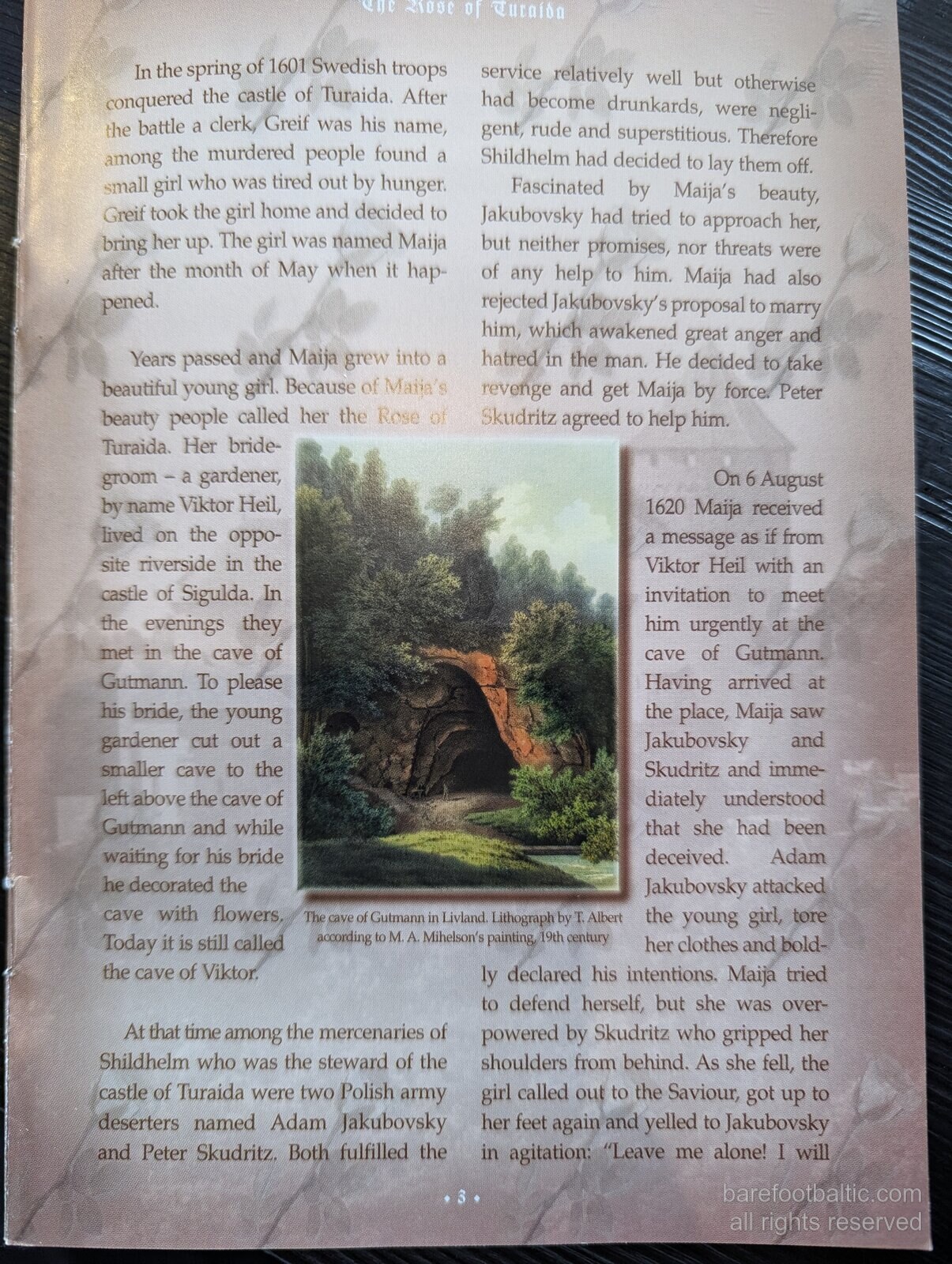
In the spring of 1601, in one of the smaller skirmishes of the long Polish-Swedish war over Livonia, Swedish troops took the castle of Turaida. After the battle, a clerk in the Swedish administration named Greif walked through the burned-out village and found, among the murdered bodies, a small girl who was still alive. Weeks old. Hungry but uninjured. He took her home, fed her, and decided to bring her up.
He named her Maija, after the month she was found.
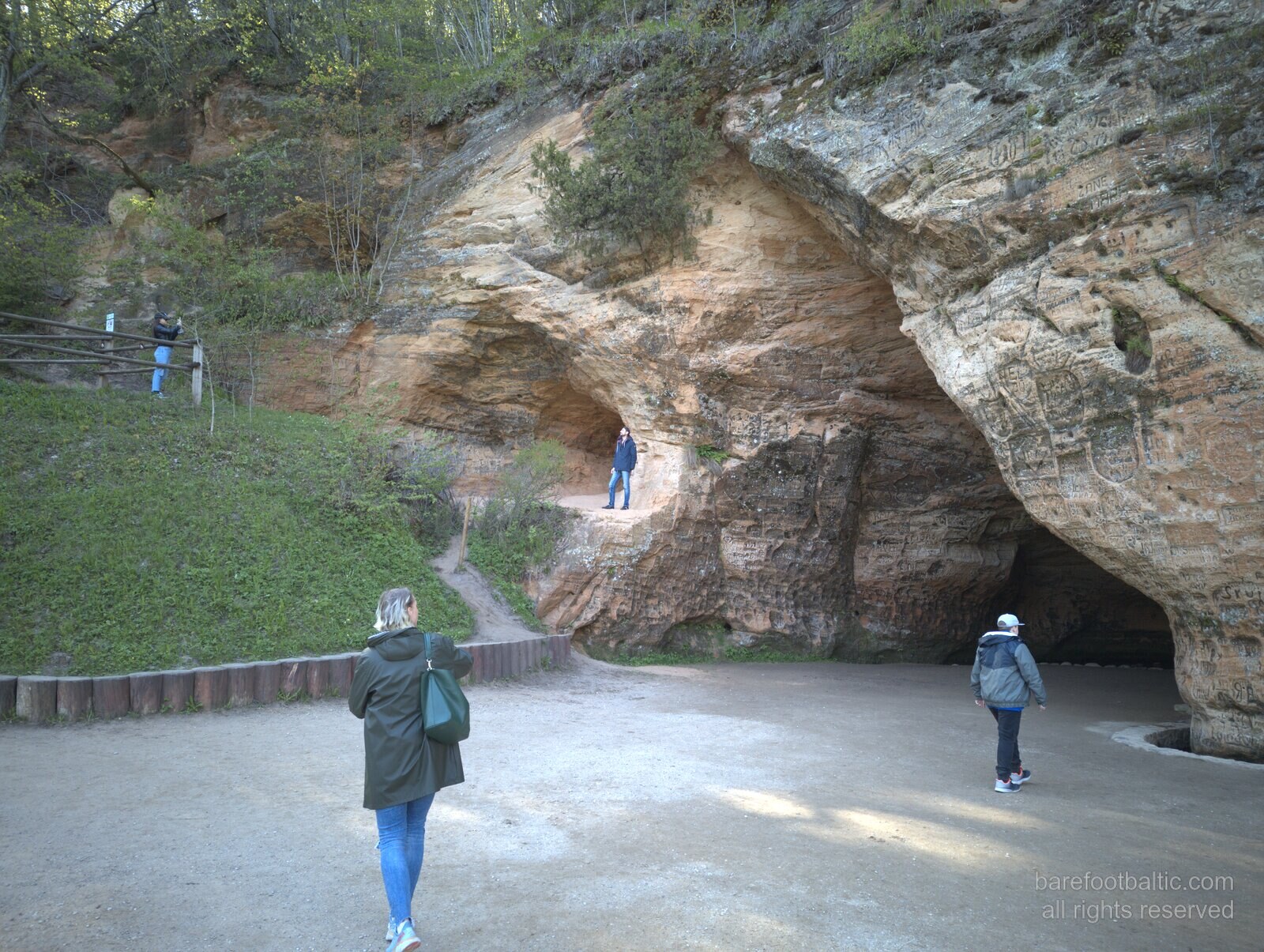
Twenty years pass. The clerk's foster daughter has grown up to be such a beauty that the people of Turaida have stopped calling her by her name and call her, simply, the Rose. Turaidas Roze. Her bridegroom is Viktor Heil (Vikturs Heils in Latvian), a young gardener employed at the new castle of Sigulda, on the other side of the Gauja river. In the evenings, he and Maija meet at the cave called Gutmaņa ala, Gutmanis Cave, a sandstone hollow scooped out of the river bank, where a freshwater spring still runs. To make her happier, Viktor cuts a smaller cave on the left side of the main one, where he leaves flowers for her to find. She is, after all, the Rose.
The two soldiers
Garrisoned at Turaida castle are two Polish mercenaries left over from the wars, Adam Jakubovsky and Peter Skudritz. Skudritz is the more dangerous of the two. Older, harder, fascinated with Maija to the point of obsession. He asks Jakubovsky, who has a softer way with women, to act as a go-between and help him win her. Maija refuses both of them. Several times.
Skudritz decides to take her by force. Jakubovsky agrees to help.
6 August 1620
On the morning of 6 August 1620, a messenger arrives at the new castle of Sigulda for Maija, with a note he says is from Viktor. Come to the cave urgently. Maija leaves immediately, walks the path to Gutmaņa ala, and finds the two Poles waiting for her. She understands at once.
She fights. Jakubovsky grips her by the shoulders. She pulls free and shouts at him to leave her alone. Then, according to the court testimony recorded later, she does something strange. She tells Adam she will give him the most precious gift in the world, one that not even a king can give. Her magic scarf, which makes the wearer invulnerable to any weapon. To prove it, she ties the scarf around her own neck and tells Adam to strike her with his sword. He does. The scarf does not protect her, and he kills her with the first blow.
What had happened was that Maija had decided to die rather than be defiled. Skudritz had been expecting Adam to murmur some incantation. Adam, trusting that the magic was real, had swung with full force. He stood over her body for a long time, not believing it. Then he ran.
Skudritz disappeared. Adam was found later in the woods near the cave, having killed himself with his own sword. He had driven it into the trunk of a tree and fallen forward onto the blade. The freshwater spring beside which he died is still there.
The next afternoon, Viktor came to the cave to wait for Maija and found her instead.
What the court did
The case was heard by the Royal Land Court of Livland in the weeks that followed. Viktor was accused first. The bridegroom is always the first suspect. He denied it, and the physical evidence pointed elsewhere. Skudritz held out under questioning. The thing that finally cracked the case was that Skudritz's eight-year-old daughter told the judges what she had heard her father say at home. He was convicted.
- Peter Skudritz was sentenced to be exiled to Lithuania, his motherland. The court considered that a mercy, because the alternative was execution. His body, when he died years later, was buried with all his weapons in a deep bog near the Nurmizu estate, so that he could not return.
- Adam Jakubovsky's body, since suicide ruled out a Christian burial, was sentenced to four months of public exposure as an old Livonian punishment. He was then buried in a marsh.
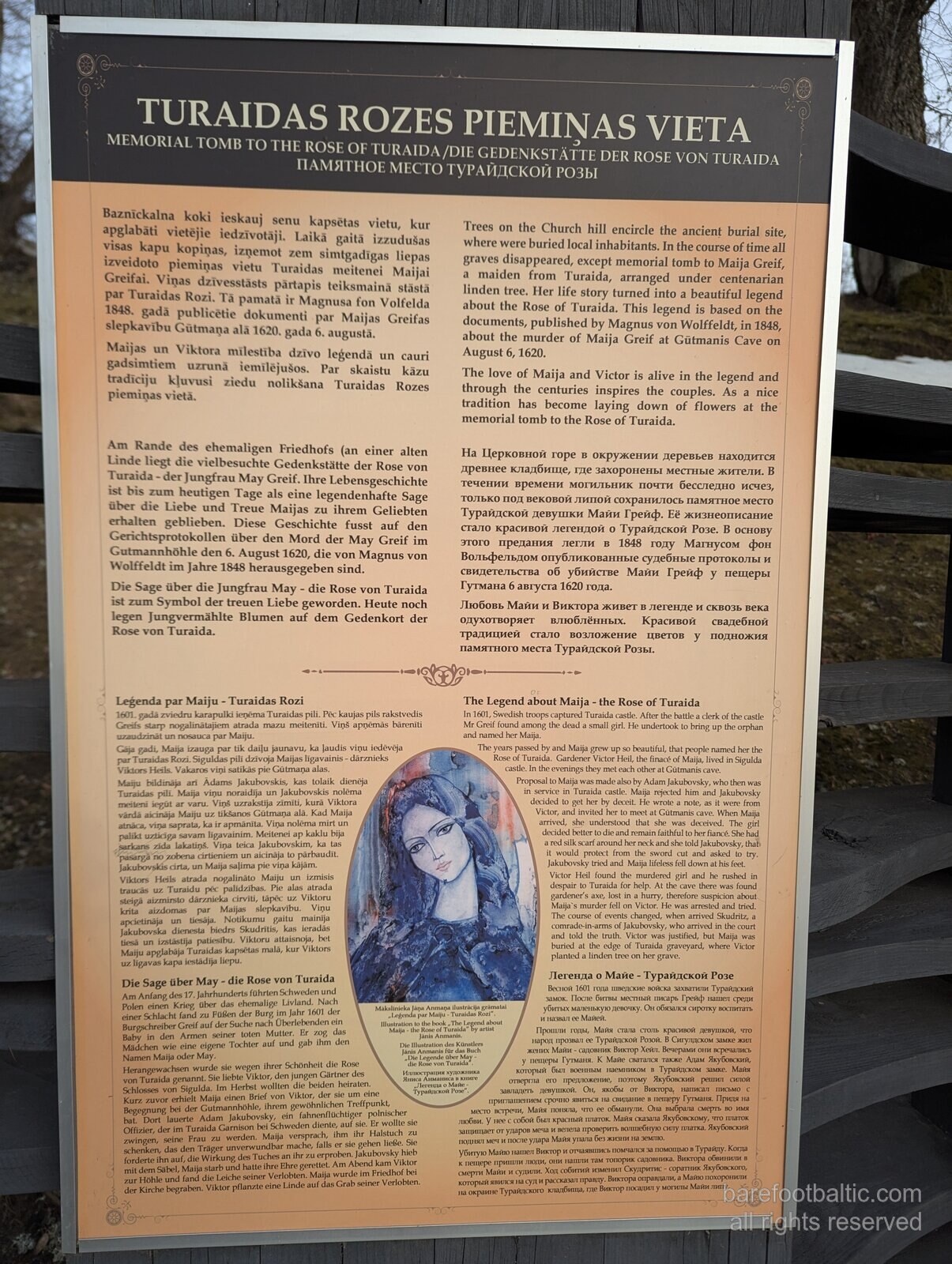
- Viktor Heil was acquitted. He buried Maija on the left side of the new wooden church at Turaida, planted a linden tree on her grave, said a prayer, and left Latvia. He went home to Württemberg, in the south-west of what is now Germany. He never married. The booklet sold at Turaida puts it this way. His broken heart could not find peace here.
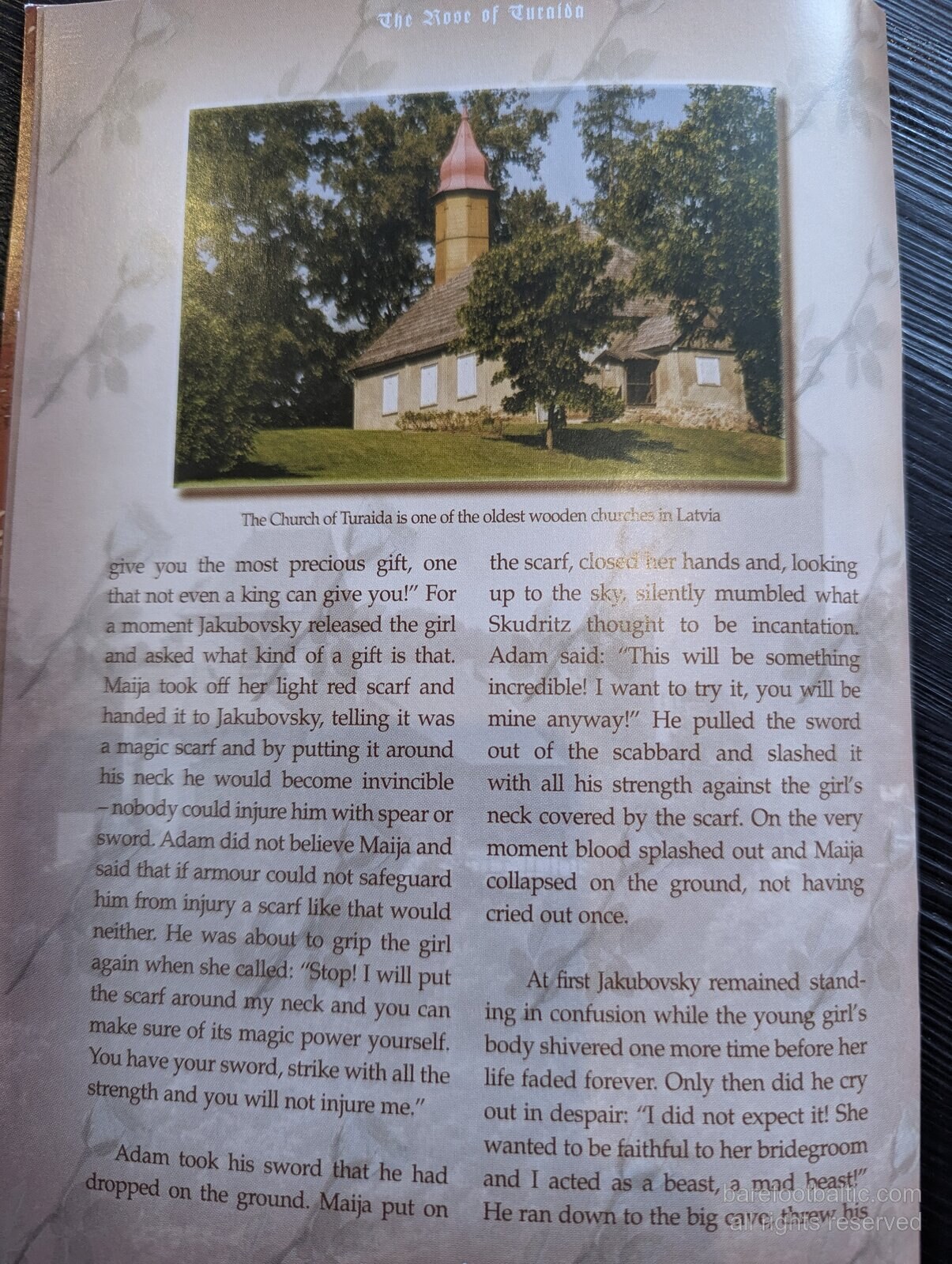
The wooden Church of Turaida he buried her next to is still there. It was built in 1750, one of the oldest wooden churches still standing in Latvia. The linden tree is still there too. The stone over her grave reads, in Latvian, the words the legend has always put in her mouth. Labāk man dvēselīte cieta, nekā mans gods un mīlestība. "Better my soul should suffer than my honour and my love."
How we know any of this
This is the part of the story that we, as Latvian guides, find most interesting. The Rose of Turaida is not a folktale that grew up over centuries. It is a lawsuit.
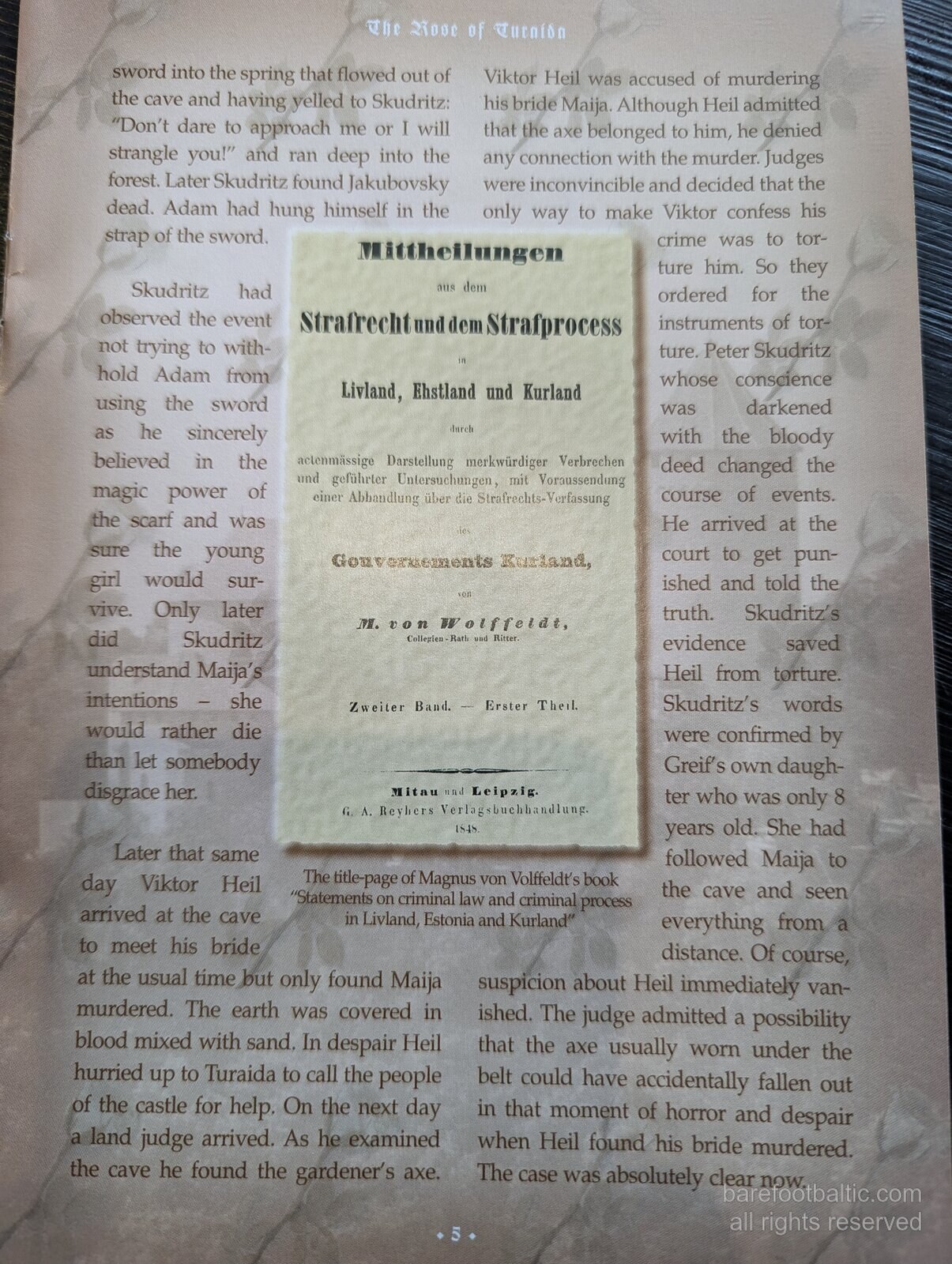
In 1848, a German-Baltic jurist named Magnus von Wolffeldt, a member of the Supreme Court of Livland, published a forbidding two-volume book in Riga and Leipzig. Its title was Mittheilungen aus dem Strafrecht und dem Strafprocess in Liv-, Estland und Kurland, which is to say Notes on Criminal Law and Criminal Procedure in Livland, Estland and Kurland. Inside it, in the second volume, was the original 1620 court protocol of the Royal Land Court of Livland, signed by the steward of Turaida, Pavel Schildhelm, and the presiding judge. Names, dates, charges, the disposition of the bodies.
For most of the 19th and 20th centuries, scholars assumed Wolffeldt had invented the underlying case to teach a moral lesson about Livonian criminal procedure. They thought he was a glib lawyer with a romantic streak. They were wrong. In the middle of the 19th century, when Riga Castle was being reconstructed, archive documents of the old Livland Supreme Court were uncovered in the underground cellars. Among them was the original murder report from the cave of Gutmanis, signed by Pavel Schildhelm, steward of Turaida castle. Two independent documents, recovered from two different places, describing the same case in the same words.
The legend is real. Maija is real. We don't know exactly what she said before she died. That part is the legend doing what legends do. But we know that on 6 August 1620, in a sandstone cave on the Gauja, a young woman from Turaida castle was murdered by two Polish soldiers, and a young gardener from Württemberg buried her on his own.
The afterlife of the story
After 1848, the case escapes the lawyers and enters Latvian and German literature.
- 1848, the German-Baltic poet Adalbert Kammerer publishes Die Jungfrau von Treyden, The Maiden of Turaida, in Riga. A modest poem. Later commentators called him "a glib composer of verses, full of romantic flourishes and antique deities."
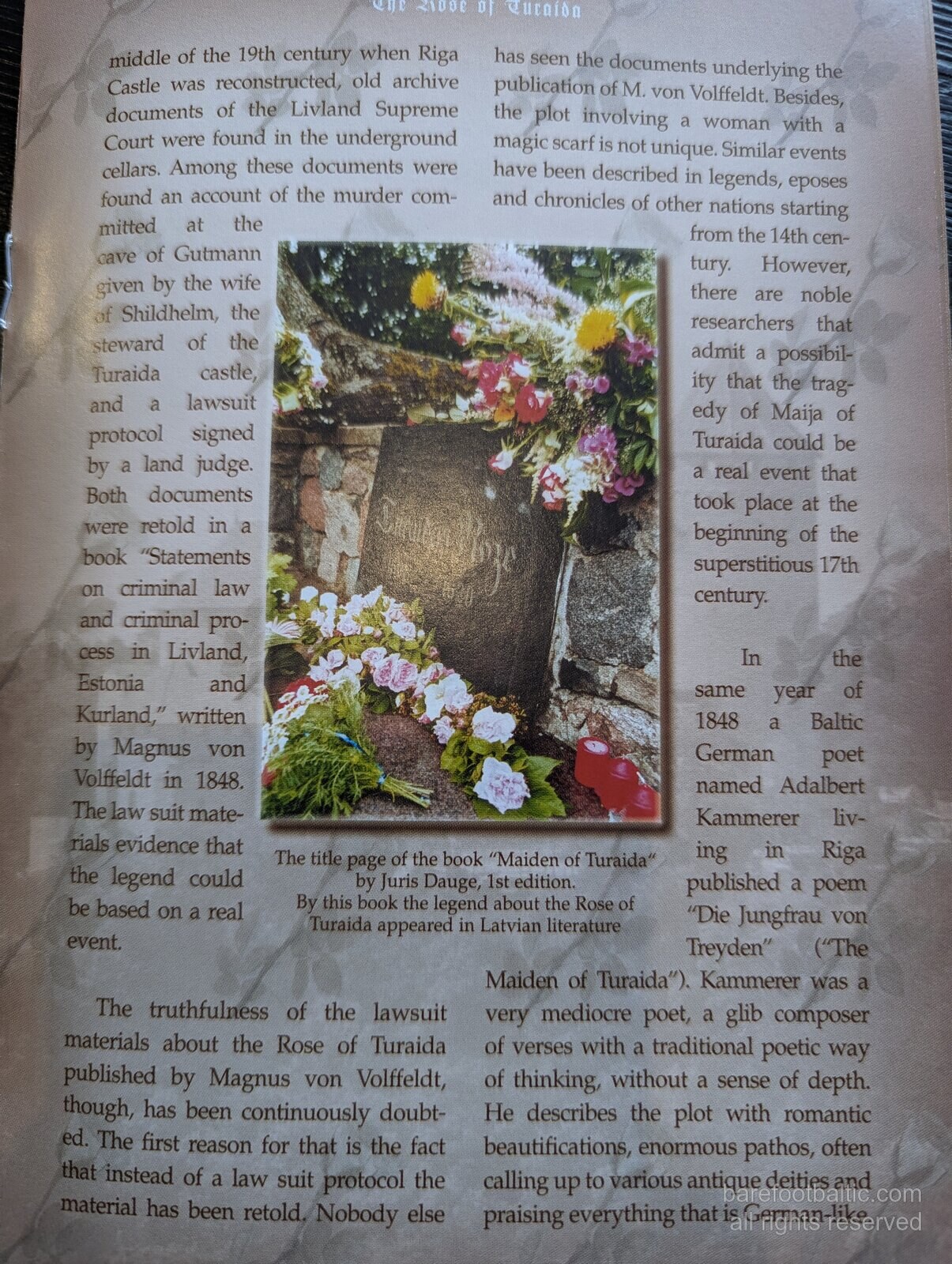
- 1857, the Latvian writer Juris Dauge publishes a Latvian-language version, Turaidas Roze, in Dorpat (now Tartu). For Dauge, Maija is no Romantic German heroine in a tower. She is "an ordinary, honest, loving girl who chose to die rather than lose her dignity." This is the version that becomes the Latvian national one.
- 1865, an Estonian translation appears.
- 1887, first Latvian reprint. By 1987 there have been four editions.
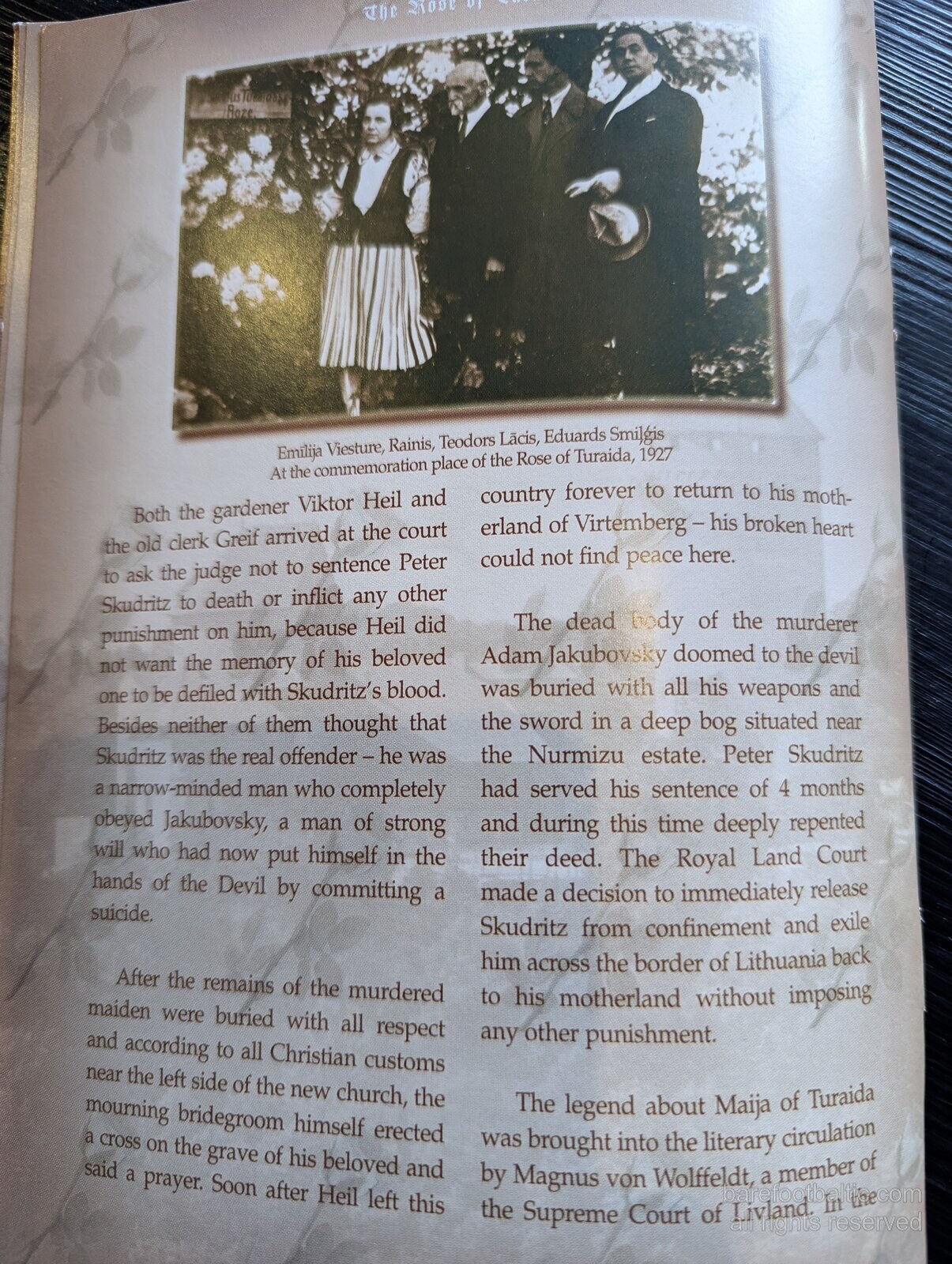
- 1926, Latvia's national poet Rainis writes Mīla stiprāka par nāvi (Love Stronger Than Death), staged the same year by the great director Eduards Smilģis at the Daile Theatre in Riga. The play is a hit. People start travelling to Turaida specifically to see Maija's grave. Rainis himself never doubted the truth of the legend.
- 1966, the composer Jānis Kepitis writes a ballet, The Rose of Turaida, staged in Riga.
- 1976, a film, In the Shadow of the Sword, is shot.
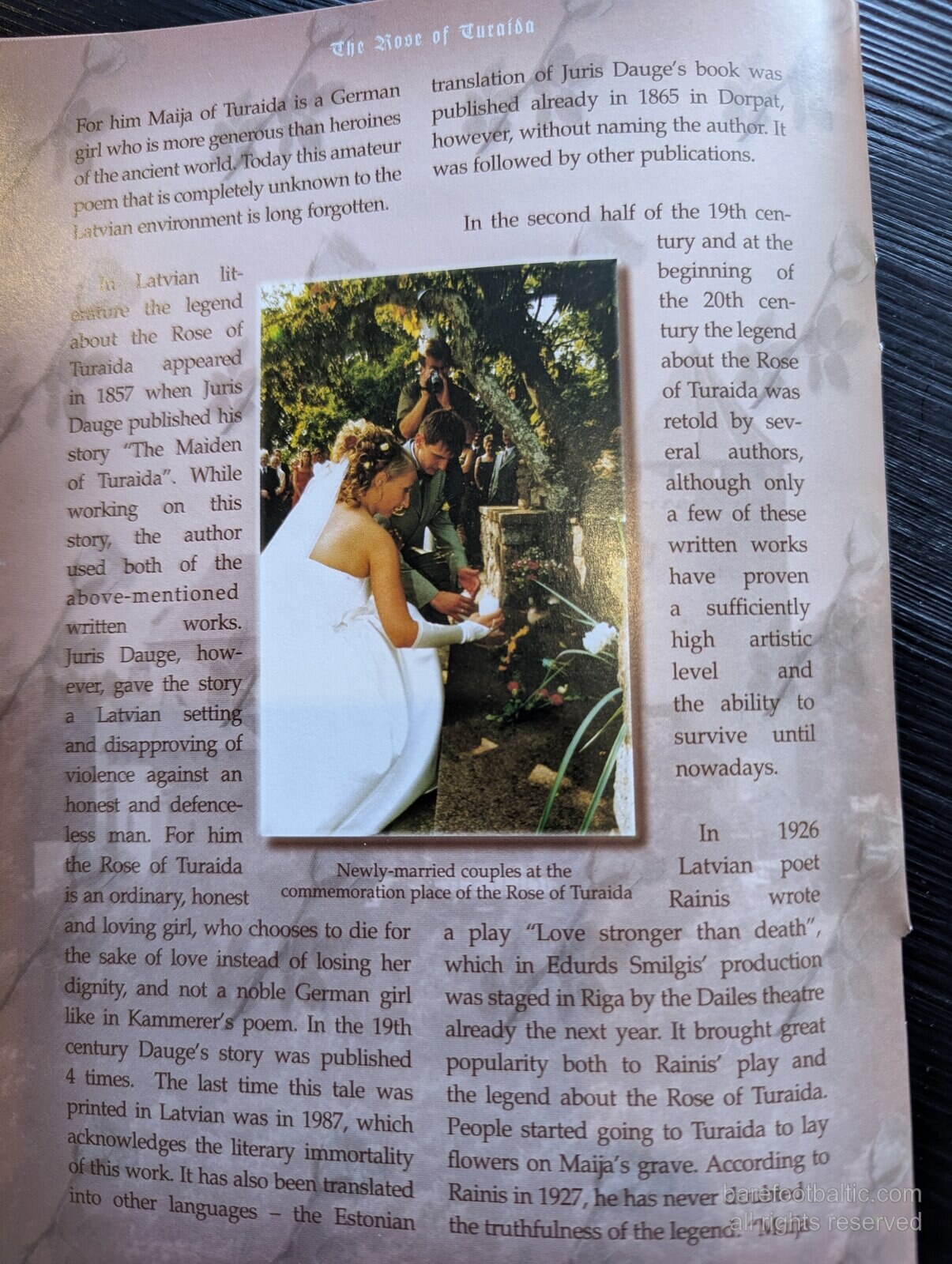
- 1997, the Latvian Post issues a EUROPA stamp, Legenda par Turaidas Rozi, designed by Juris Utāns and printed in the Netherlands. It is the stamp at the top of this page.
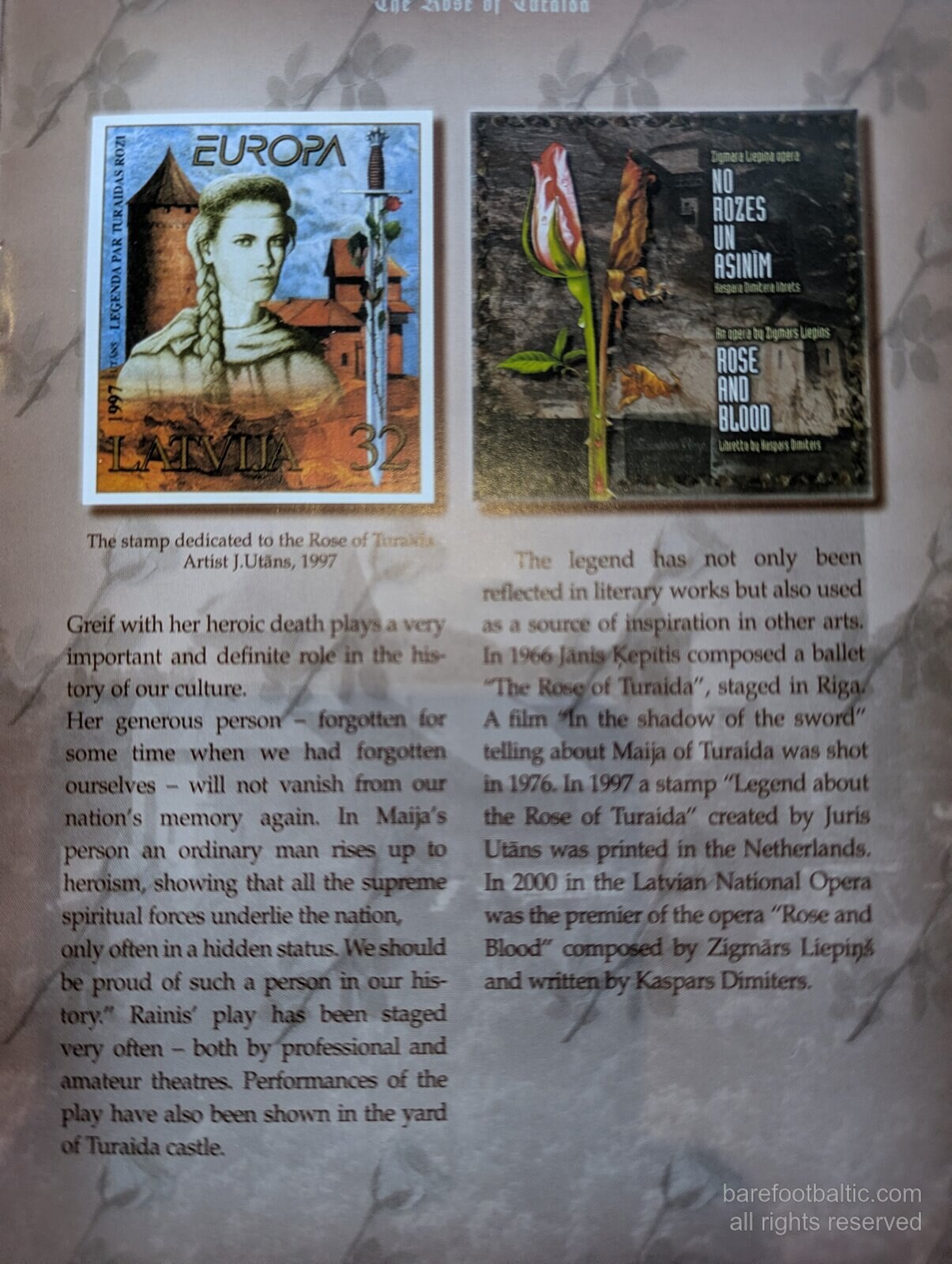
- 2000, the Latvian National Opera premieres Rozes un Asinis, Rose and Blood, composed by Zigmārs Liepiņš to a libretto by Kaspars Dimiters.
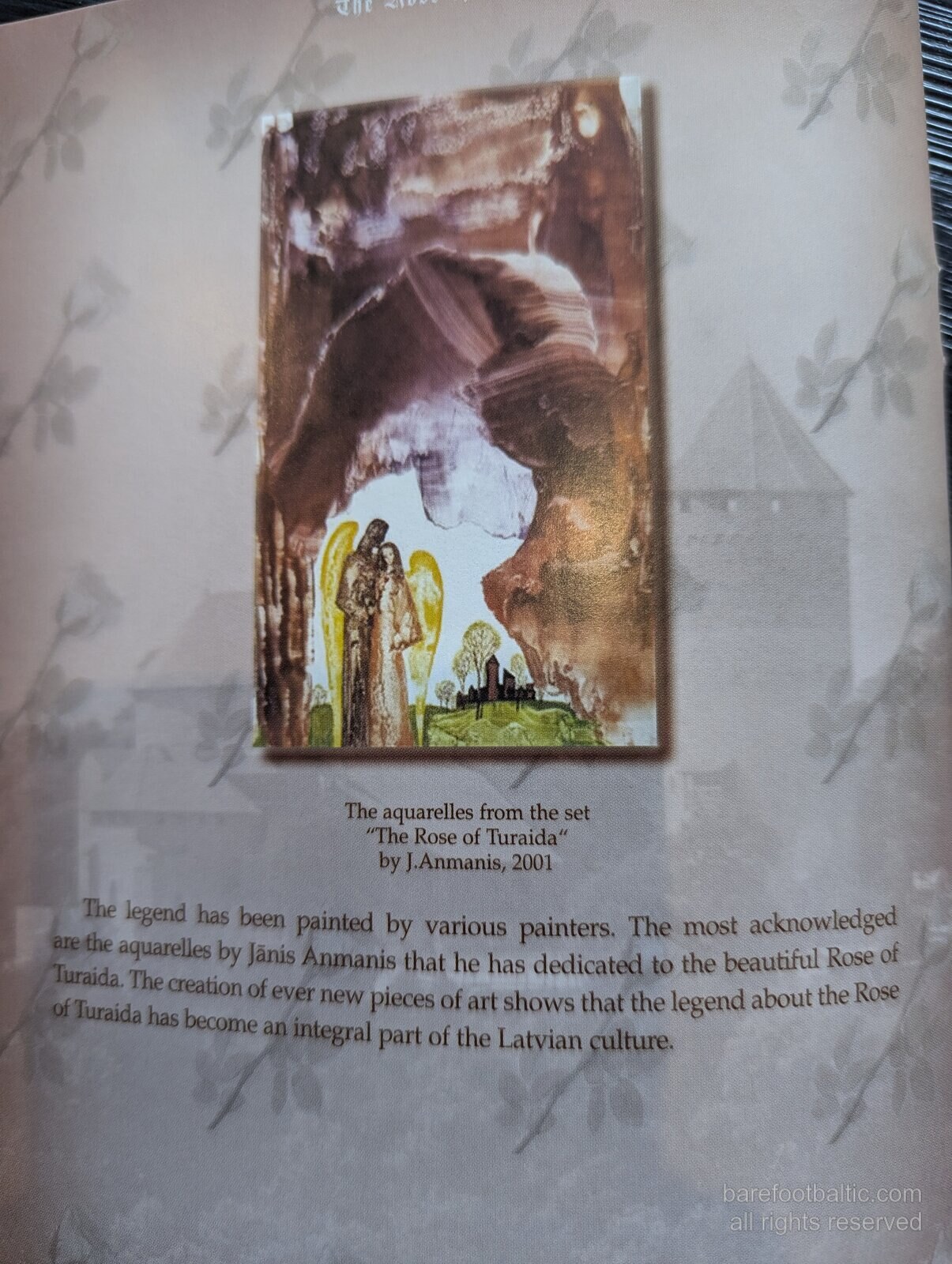
- 2001, the Latvian painter Jānis Anmanis publishes a set of aquarelles, The Rose of Turaida, that are now considered the definitive visual treatment.
Visiting Maija today
Maija's grave is at the Turaida Museum Reserve, on the hill of Turaida just outside Sigulda, about 50 km north-east of Riga.
You walk up from the parking lot toward the wooden church, the second-oldest wooden church still standing in Latvia, built in 1750. Maija's grave is on its left, marked by a low stone with a Latvian inscription. Viktor's linden, planted 1620, is still alive. Another has grown up beside it. Flowers on the stone year-round.
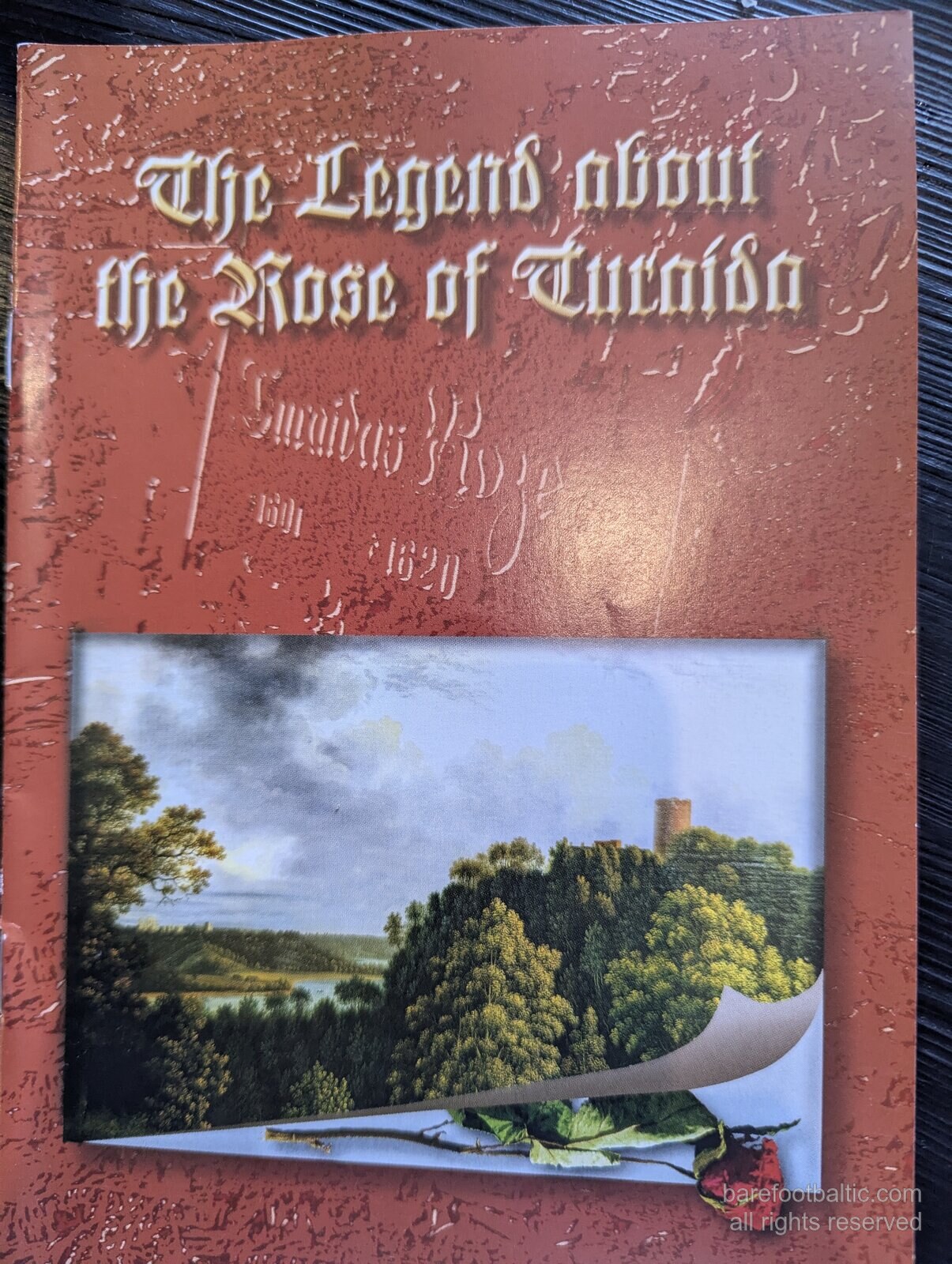
It is a Latvian wedding tradition to come to this grave on the day of one's wedding, usually right after the registry-office ceremony, in a small group. The newly-married couple lays the bridal bouquet on Maija's stone, takes one photograph, and leaves. Some couples leave the bouquet behind. The booklet at the Turaida Museum, The Legend about the Rose of Turaida, sells well partly because foreign tourists ask, slightly bewildered, what are these brides doing here? are we allowed to watch?
From the grave, walk down the hill toward the river. Gutmaņa ala, Gutmanis Cave, is a fifteen-minute walk on a marked path. It's a real working sandstone cave, ten metres deep, with a freshwater spring at the back that has always been considered curative. The smaller hollow Viktor cut for Maija's flowers is still there. So is the carved graffiti. Visitor names from the 17th, 18th and 19th centuries scratched into the soft sandstone, including initials supposedly belonging to soldiers who passed through during the Northern War.
It is, if you pause for a minute, an unsettling place to stand.
Why we send guests
Latvians don't have many medieval saints. The Lutheran Reformation of the 16th century scrubbed most of them out. The few that survived, like the Madonna of Aglona, are Catholic, in a country that is statistically one of the most secular in Europe. What we do have, instead, is a young woman from a frontier castle in 1620 who chose to die rather than be raped, and a court that believed her.
Maija isn't a saint. She is not in any liturgy. But she occupies, in Latvian culture, the same emotional space a saint occupies. Couples ask for her blessing on their marriage and plant flowers at her grave. She gets onto the postage stamps.
If you have a day in Sigulda, and you should, give it half an hour. Walk up to the wooden church and stand at the grave on the left side. Then down to the cave, read the names cut into the sandstone walls, and decide for yourself whether there is anything to the story.
We think there is.
Want to see Turaida, the cave, the wooden church, Maija's grave, as part of a wider trip through the Gauja valley? Get in touch. Our small-group walking tours through Sigulda are designed around exactly this kind of detail.